


Products Description
Panel Rockwool for Roof is 1000mm, with customization options of 950mm and 1120mm available. Panel thickness is selectable from 50-200mm, with 100mm, 120mm, and 150mm being common roofing specifications. Panel length can be customized as needed. The panels are made of double-layer aluminum-zinc coated steel sheets, with an outer layer thickness of 0.5-0.8mm and an inner layer thickness of 0.4-0.7mm. They are compatible with various coatings such as PE, SMP, and PVDF.
The sides are sealed with polyurethane edge-sealing with a density of 38-40kg/m³, effectively preventing cold bridging and moisture absorption by the rock wool. The panels are lightweight, with a standard 100mm thick panel weighing approximately 18-20kg/m². They use concealed nail lap joints and are suitable for roof slopes of at least 3%. The operating temperature range is -50℃ to +80℃.
Product Specification
|
Products Title |
Panel rockwool for roof |
|
PPGI Thickness |
0.4-0.7mm for choose |
|
Panel Thickness |
40/50/75/100/120/150/200mm |
|
Color |
any other required on RAL Color |
|
Rock wool Density |
80-120kg/m³ |
|
Effective Width |
950-1150mm for wall panel,980-1000mm for roof panel |
|
Length |
Max 11.85mm for 40HQ container or customized |
|
U Value(w/mk) |
Rock wool:≤0.043 |
|
Fire Rating |
Rock wool:CLASS A |
|
Surface Texture |
Flat/Embossed Pattern/V8/Micro Ripple |
|
Application |
Factory /workshop/Steel Steel Construction |
Factory Workshop
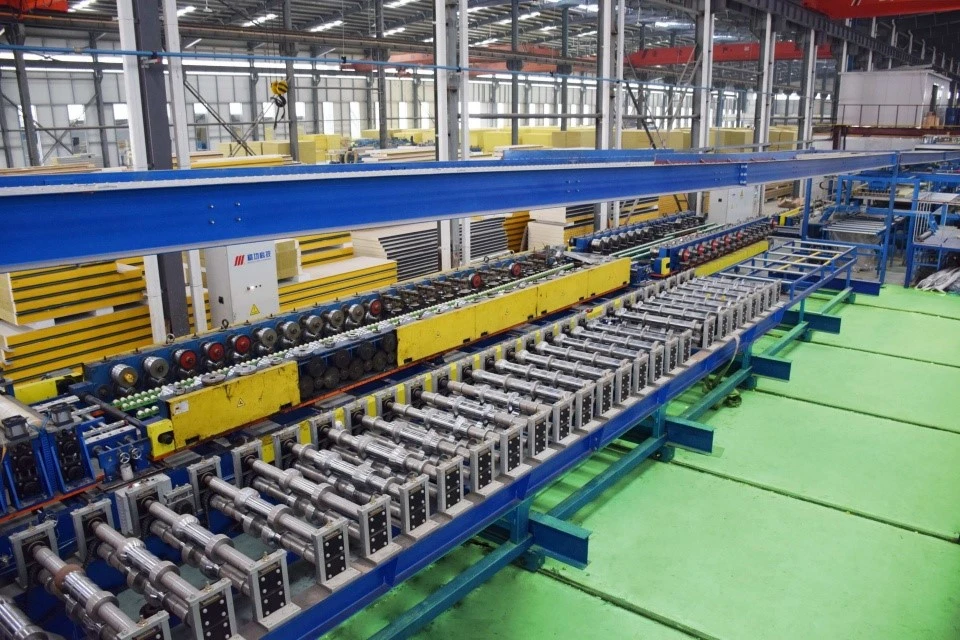
The entire panel is produced in an integrated, fully automated continuous production line. It undergoes a complete set of standardized processes, including raw material inspection and pretreatment, steel plate roll forming, precise cutting and vertical arrangement of rock wool, high-pressure polyurethane foam sealing on both sides, high-temperature and high-pressure overall composite bonding, CNC fixed-length cutting, finished product appearance and performance quality inspection, and cleaning, packaging and warehousing.
This ensures that the panels are firmly bonded, dimensionally accurate, have a regular shape, and are free of hollow areas and delamination. The overall quality is stable and reliable, fully meeting the fireproof, heat insulation, waterproof, load-bearing, and long-term low-temperature use requirements for the roofs of small and medium-sized steel structure factories and warehouses.
Roof Panel Project
Class A fire resistance + dual safety for high-temperature photovoltaic applications: The backsheet temperature of the module can reach 60–80℃, and the rock wool remains non-combustible and does not melt or drip.
98% water repellency: Condensation/rainwater from the photovoltaic roof does not affect the insulation, avoiding "wet board failure."
PU edge sealing for thermal bridging: 15% more energy efficient than pure rock wool boards, providing dual energy savings for both photovoltaic and insulation applications.
360° seamless joints without perforation: Photovoltaic bracket clamp installation does not damage the waterproofing.
Load-bearing capacity: 100kg/m³ rock wool density meets the combined stress requirements of photovoltaic modules, snow load, and wind load.

Our certification

Element Certification

Element Certification

Element Certification

Element Certification

Element Certification
Q: What is a PU edge-sealed rock wool sandwich panel?
A: It is a composite insulation panel with a hydrophobic rock wool core (100kg/m³) and polyurethane (PU) foam sealing on both longitudinal edges.
Q: What fire rating does this panel achieve?
A: The rock wool core is Class A non-combustible (melting point > 1000°C), and the PU edge seal is B1 flame-retardant.
Q: Why use hydrophobic rock wool at 100kg/m³ for solar roofs?
A: Solar roof panels are exposed to extreme temperature cycles and condensation. Hydrophobic rock wool has a water repellency rate ≥ 98% and volume water absorption ≤ 2%, preventing insulation degradation from moisture.
Q: How does the PU edge improve thermal performance?
A: Pure rock wool panels suffer from thermal bridging at the joints. PU foam (λ ≤ 0.024 W/m·K) seals the edges, reducing overall U-value to ≤ 0.4 W/(m²·K) for a 100mm panel - approximately 15% better than conventional rock wool panels.