

Refrigeration units, as core temperature control equipment in cold storage and other similar applications, work by transferring and releasing heat through the phase change of the refrigerant cycle, ultimately maintaining the required low-temperature environment inside the equipment. The following breakdown of the entire working process, based on the characteristics of key components, provides a clear understanding of how each component works collaboratively to ensure refrigeration efficiency.
I. Core Component Collaboration: The Foundation of the Refrigeration Cycle
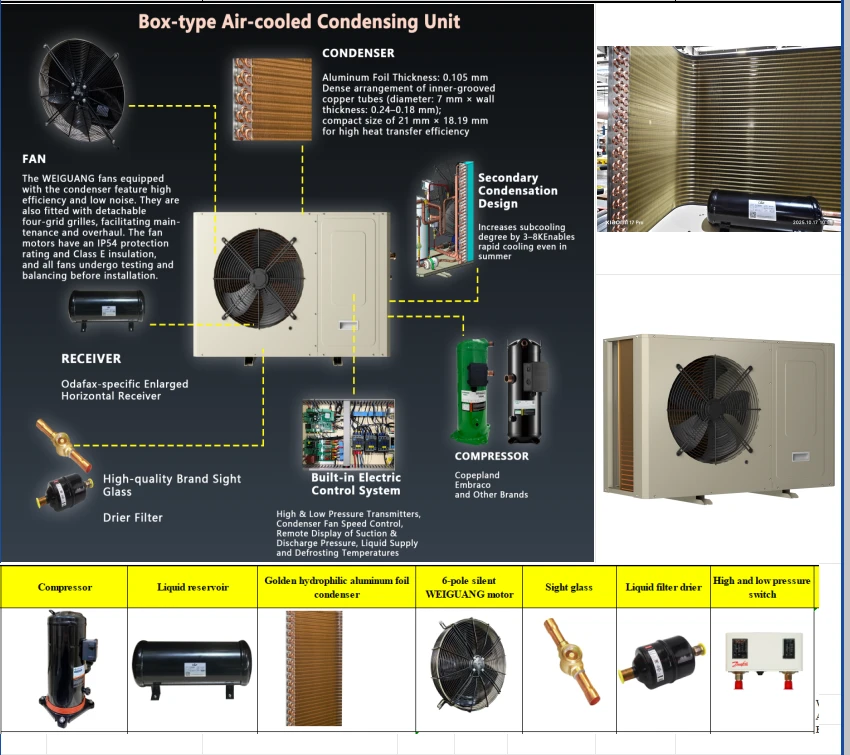
The efficient operation of a refrigeration unit relies on the precise coordination of the compressor, condenser, receiver-dryer, expansion valve, evaporator, and built-in electronic control system. Each component performs its specific function while simultaneously interacting to form a complete refrigeration closed loop.
1. Compressor: The "Power Core" of the Refrigeration Cycle
The compressor is the heart of the entire refrigeration system. Mainstream brands such as Copeland and Embraco are recommended for stable operation. Its core function is to compress the refrigerant gas, increasing its temperature and pressure through work, transforming the low-pressure, low-temperature refrigerant vapor into a high-pressure, high-temperature gas, creating conditions for subsequent heat release. Before leaving the factory, all compressors undergo dynamic balancing tests and are equipped with IP54-rated, E-class insulated motors, ensuring both dust and moisture resistance and long-term operational safety and stability.

2. Condenser: The "Key Link" in Heat Release
The high-pressure, high-temperature refrigerant gas, compressed by the compressor, enters the condenser. This condenser uses 0.105mm thick aluminum foil and 7mm diameter, 0.24-0.18mm wall-thick internally threaded copper tubes, densely arranged in a compact configuration (21mm × 18.19mm) to significantly improve heat exchange efficiency. During this process, the high-temperature refrigerant gas releases heat to the surrounding environment, gradually condensing into a high-pressure liquid. Simultaneously, the secondary condensation structure increases the subcooling by 3-8K, ensuring rapid heat release even in high-temperature summer conditions and maintaining cooling efficiency. The accompanying Weiguang fan features high efficiency and low noise, and its removable four-compartment protective mesh facilitates routine maintenance, providing strong support for stable heat dissipation from the condenser.
3. Receiver Tank: The "Stable Reserve" for Refrigerant
The condensed high-pressure liquid refrigerant flows into a custom-made, enlarged horizontal receiver tank. Equipped with a high-quality sight glass and a dryer filter, the receiver tank allows for real-time monitoring of refrigerant levels, filters impurities, and absorbs moisture, preventing foreign matter from affecting circulation efficiency and ensuring the stability of the subsequent refrigeration process, thus safeguarding the long-term reliable operation of the unit.

4. Expansion Valve: The "Regulator" of Pressure and Temperature
The high-pressure liquid refrigerant flowing from the receiver tank passes through the expansion valve (metering device). At this point, the refrigerant's pressure and temperature rapidly decrease. This sudden pressure drop causes some refrigerant to vaporize, forming a low-pressure, low-temperature liquid-gas mixture, preparing for subsequent heat absorption.
5. Evaporator: The "Core Site" for Heat Absorption
After entering the evaporator, the low-pressure, low-temperature liquid-gas mixture absorbs heat from the surrounding environment (such as the air inside the cold storage), gradually evaporating into low-pressure vapor. This process directly lowers the ambient temperature, thus meeting the refrigeration needs of cold storage facilities and maintaining the required low internal temperature to ensure the safe storage of perishable goods or temperature-sensitive materials.
6. Built-in Electronic Control System: The "Intelligent Command Center" for the Entire Process
The entire refrigeration process is precisely controlled by a built-in electronic control system. This system integrates high and low pressure sensors, condenser fan speed control, and remote display of suction and discharge pressure/liquid supply/defrost temperature. By monitoring parameters at each stage in real time, it automatically adjusts key indicators such as compressor speed and refrigerant circulation volume to ensure the refrigeration unit always operates at high efficiency. It also allows users to remotely monitor equipment operation, reducing maintenance complexity.
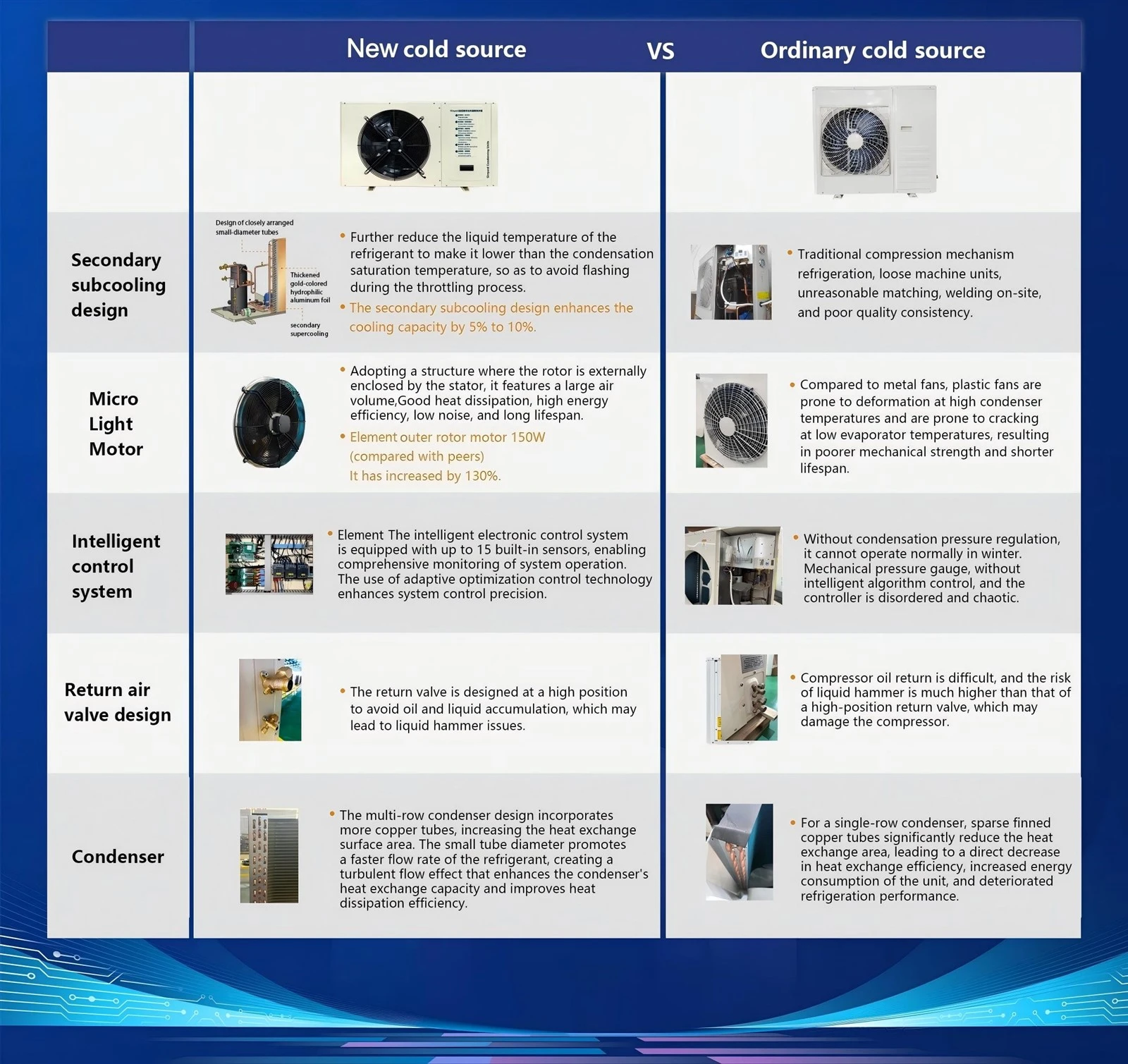
II. Complete Refrigeration Cycle: Continuous Heat Transfer
The above components work together to form a continuous refrigeration cycle: refrigerant vapor is compressed into a high-pressure, high-temperature gas by the compressor → enters the condenser, releases heat, and condenses into a high-pressure liquid → flows into the liquid storage tank for stable storage → passes through the expansion valve to reduce pressure and temperature, forming a liquid-gas mixture → enters the evaporator to absorb heat and evaporate into low-pressure vapor → is drawn back into the compressor, repeating the cycle. Through this continuous process of "compression-condensation-expansion-evaporation," heat is constantly transferred from the internal environment to the external environment, thereby maintaining a consistently low internal temperature.
III. Temperature Control: Precisely Adapting to Usage Needs
The core of the refrigeration unit's temperature control is achieved through its built-in electronic control system, adjusting parameters such as compressor speed, refrigerant circulation volume, and temperature setpoint. Whether it's the normal temperature requirements for daily storage or the rapid cooling needs in high-temperature summer environments, the unit can precisely regulate the temperature through the coordinated operation of its components, ensuring a stable storage environment and effectively protecting the quality of perishable goods or temperature-sensitive materials.
Understanding the working principle of the refrigeration unit helps in better understanding its characteristics, performing daily maintenance, fully leveraging the unit's high-efficiency cooling advantages, extending its service life, and providing reliable assurance for your usage needs.