


Sealing the joints of cold storage panels is far more complex than simply "applying a bead of sealant."
After a period of use, many cold storage facilities begin to experience issues such as condensation at the joints, localized frost accumulation, increased energy consumption, and even moisture ingress or blistering within the insulation layer. These problems rarely stem from the failure of a single material; rather, they occur because the various junctions-such as panel seams, corners, ceiling suspension points, and pipe penetrations-fail to form a continuous, integrated sealing system.
To effectively seal cold storage panel joints, one must focus on three core requirements: maintaining a continuous insulation layer, ensuring airtight integrity, and effectively managing structural movement.
1. Basic Requirements for Sealing Joints in Cold Storage Panels
01. The insulation layer must be continuous to avoid "thermal bridges."
The core of the insulation panels should remain as continuous as possible, without being interrupted by metal components, gaps, or breaks. If panel joints are not handled properly, heat can penetrate the cold storage space through these breaks, leading to lower temperatures near the joints, as well as condensation and frost formation.
Particular attention must be paid to junctions-such as where wall panels meet the ceiling or floor, at corners, and at suspension points-to ensure that the insulation layer is not directly severed by metal structural elements.
02. Joints must be airtight and moisture-proof.
The exterior of a cold storage unit is exposed to warm, humid air, while the interior contains cold air. If gaps exist at the joints, water vapor can enter the insulation layer; upon cooling, it may condense and freeze, causing the insulation to expand, delaminate, or bulge.
Therefore, panel joints must not merely be "filled"-they must form a continuous, airtight seal. This is especially critical for low-temperature and freezing storage facilities.
03. Allow for thermal expansion and contraction of panels rather than rigidly constraining them.
Cold storage panels expand and contract with temperature fluctuations. If the joint design is entirely rigid and prevents such movement, the joints may crack, causing the sealing layer to fail.
The correct approach is to ensure that joints can accommodate a certain degree of movement while maintaining an effective seal.
2. How to Handle Common Joint Connections
01. Vertical joint between wall panels
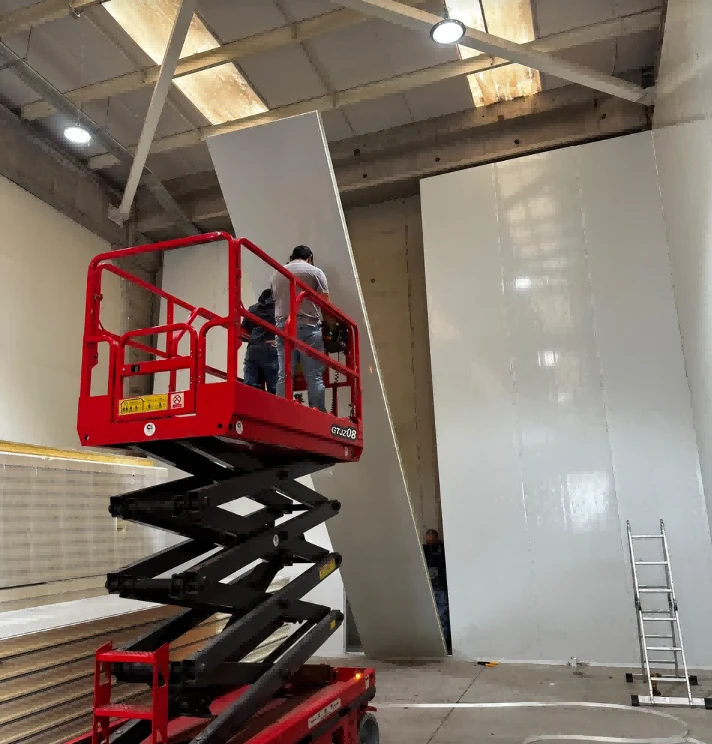
Vertical joints between wall panels are the most basic, yet often overlooked, seals.
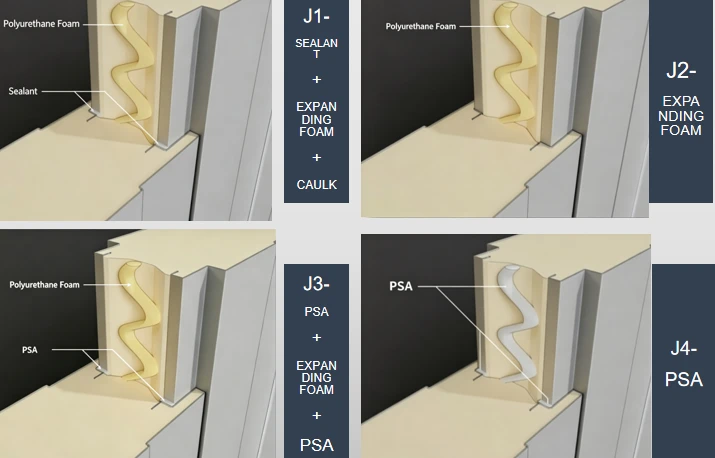
Tight fit: Keep panel joints as tight as possible to minimize visible gaps.
Insulation fill: Fill gaps with insulation/sealant materials to ensure continuous insulation.
Continuous sealing: Apply a continuous sealant layer on the exterior/warm side to block moisture.
Smooth interior: Ensure the interior seal is smooth for easy cleaning and to prevent dust buildup.
If gaps are too large on site, do not just "force-fill" with sealant. Fill them with insulation material first, then seal. This prevents the sealant from being too thick and cracking.
02. Internal and external corner joints
Corners of a cold room experience the most complex stresses and are highly prone to cracking and air leakage. At corners, panels from two directions meet, converging joints, end seams, metal parts, and insulation. These areas easily let in heat and moisture, and sealants or corner profiles are vulnerable to tearing.
Internal Corners: Prone to water and dirt buildup and mold growth. For food or high-cleanliness cold rooms, internal corners must be tightly sealed and easy to clean.
External Corners: More exposed and vulnerable to physical impact. Without proper protection, metal panels or the sealing layer can be easily damaged.
Common Construction Methods
Method A: Butt-joint with Aluminum Angle Trim
Suitable for cold storage facilities with high requirements for airtightness and aesthetics. The aluminum angle trim protects the corners and helps ensure a continuous seal.
Method B: Factory-Prefabricated Corner Panels with On-site Foam Infilling
Suitable for low-temperature cold storage or projects where achieving a proper butt-joint is challenging. Prefabricated corner panels reduce the number of on-site joints; however, care must be taken during installation to ensure that the foam infill creates a dense, airtight seal.
Method C: Butt-joint with Aluminum Angle Trim and Foam Infilling
Suitable for most cold storage projects. When applying foam on-site, the volume must be carefully controlled; insufficient foam will leave gaps, while excessive foam may cause the panel surfaces to crack or bulge.
3. Connection Joint Between Wall Panel and Roof Panel
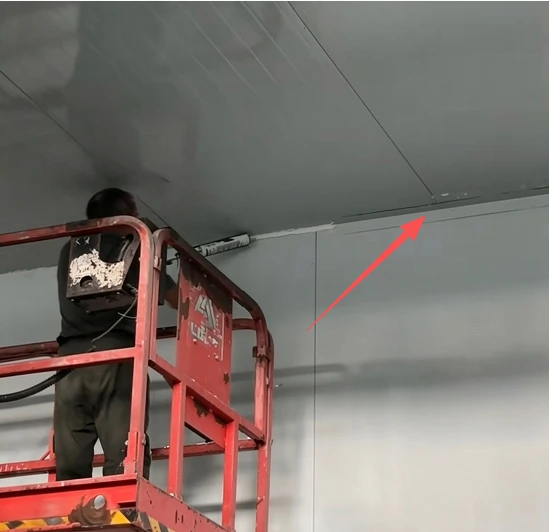
The perimeter where the wall panels meet the ceiling panels is the "lifeline" of a cold storage facility.
This area is subject to three simultaneous factors:
Structural loads: The self-weight of the ceiling panels, maintenance loads, and equipment loads may ultimately be transferred to the walls.
Air leakage: Due to the tendency for warm air to rise and cold air to sink, a pressure differential often develops near the ceiling, making it easy for air to infiltrate.
Thermal deformation: Both the ceiling and wall panels undergo contraction; if the constraints are too rigid, the joints are prone to pulling apart.
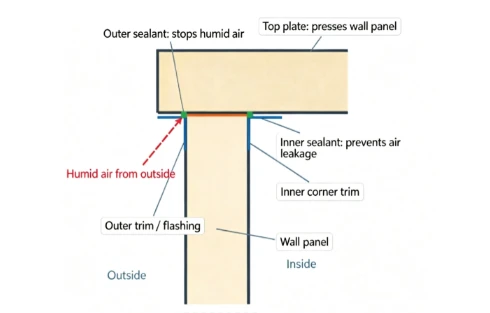
A common, straightforward load-bearing design.
Key point: The horizontal joint needs a "dual-protection" design:
Exterior: Sealant to block warm, humid air.
Gap: Completely filled with expanding foam.
Interior: Aluminum angle profile, sealed as a second barrier.
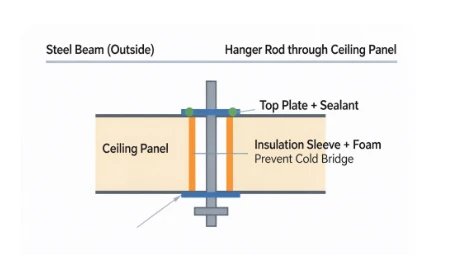
Hanging Points for Large-Span Ceiling Panels
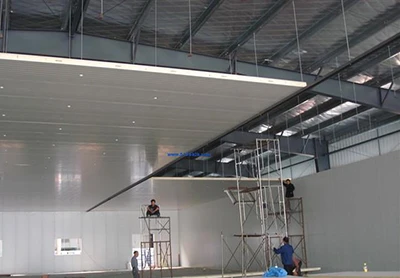
For large spans or heavy equipment, ceiling panels may be suspended from the steel structure above.
Key considerations:
Thermal bridging: Metal hangers easily form cold bridges.
Insulation: Hangers passing through panels must be insulated.
Sealing: Fill openings with insulation and seal continuously.
Interior finish: Use matching caps inside to reduce condensation risk.
4. Key Points for On-Site Joint Construction
1. Tight Joints, No Oversized Gaps
Do not level large gaps with sealant alone. Follow this sequence: clean debris → fill with insulation → seal continuously with sealant → ensure a uniform, unbroken layer.
2. Continuous Sealant, No Breaks
Cold leakage is usually caused by broken sealant, not insufficient thickness. Focus inspections on corners, pipe penetrations, hanger points, and door frame edges.
3. Proper Foam Filling
Under-filling leaves voids; over-filling warps panels. Trim uneven foam before applying the sealant layer.
4. Break Thermal Bridges at Metal Parts
Screws, angle aluminum, and hangers can form cold bridges. Minimize metal penetration through insulation; use thermal pads or sleeves where necessary; add interior cover caps to reduce condensation.
Common Issues and Inspection Methods
| Common phenomena | Possible Cause | Remedy |
|---|---|---|
| Condensation / dripping at corners & wall-top joints | Poor outer seal; humid air ingress; angle-aluminum thermal bridge | Re-seal outside; check joint filling; add insulation between aluminum & core |
| Ice inside seams; panel bulging | Moisture ingress; freeze-thaw expansion | Remove damp insulation; re-seal; close foam surface after filling |
| Sealant cracking / peeling | Thermal shrinkage; dirty substrate; overly thick bead | Low-temp elastic sealant; clean & dry substrate; re-apply |
| Top panel sagging; open joints | No suspension for long span; wall panel deformed under load | Add hangers / steel beams; re-check panel load capacity |
| Mildew / dirt buildup at inner corners | Gaps; trapped standing water | Cover with corner aluminum; use rounded profile; keep seal continuous |
why choose Element?
Getting the joint details right is the difference between a stable cold room and a costly energy leak. Henan Element provides not just insulated panels, but a complete sealing system-including panels, corner trims, and compatible low-temp sealants designed to work together.
We help clients skip the trial-and-error. Share your temperature requirements, dimensions, and installation conditions, and our technical team will review your specific joint details and provide a targeted sealing solution and quote.
Get targeted joint advice and a competitive quote - usually within 1 business day.