

1.What is Cam-lock sandwich panel?
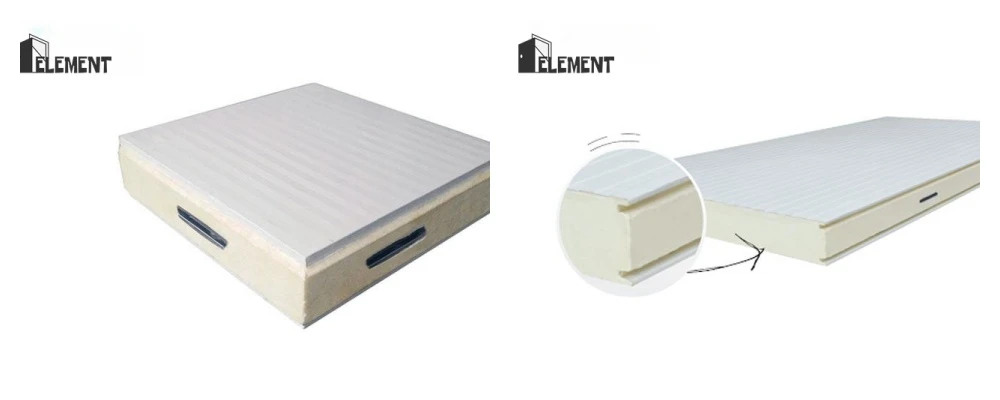
Cam-lock Sandwich Panel is a prefabricated insulated panel with built-in eccentric cam locks. It typically consists of a polyurethane (PU) core sandwiched between two metal facings, such as color-coated steel or stainless steel. The locking components are embedded inside the panel during production.
During installation, a special hex key is used to turn the locks, pulling adjacent panels tightly together. This connection allows for straightforward assembly and disassembly, making cam-lock panels a practical choice for cold rooms, freezer warehouses, and other insulated spaces.This connection method makes panel assembly more convenient and supports modular cold room construction.
Element camlock panels are built for cool rooms, freezer rooms, blast freezers and temperature-controlled storage. We tailor each system to match operating temperature, room size, product load, door cycle frequency and local site conditions.
2. Structure of a Camlock Cold Room Panel
A Camlock cold room panel consists of three main parts: metal facings, an insulation core, and eccentric cam locks.
1. Metal Facings
The outer and inner surfaces are commonly made of PPGI or stainless steel. Other options can be selected according to project requirements. These facings protect the insulation core and provide surface strength.
2. Insulation Core
PU (Polyurethane) is widely used because of its low thermal conductivity, typically around 0.022–0.024 W/(m·K), depending on the formulation and production conditions. PIR is another option for projects requiring different fire-performance characteristics.
3. Eccentric Cam Locks
The cam-lock mechanism is embedded inside the panel edges. When operated with a special hex key, it pulls adjacent panels together to create a secure mechanical connection.
3. How to Install Camlock Cold Room Panels?
Camlock panels are connected by built-in locking devices. Installation mainly involves panel positioning, locking, and joint sealing.
Step 1: Panel Positioning
Arrange the floor, wall and ceiling panels according to the project drawings. Check dimensions and alignment before connection.
Step 2: Cam-Lock Connection
Insert the special hex key into the access hole and rotate it to engage the eccentric locking mechanism.
Step 3: Joint Sealing
Apply the required sealing strips or sealant to panel joints, corners and connections to improve airtightness and insulation continuity.
Step 4: Final Inspection
Check panel alignment, locking points and sealing conditions to ensure proper installation.
Note: Mechanical locking and joint sealing work together. Final insulation performance also depends on the panel design and installation quality.
4. How to Choose the Right Camlock Cold Room Panel?
When selecting camlock panels, consider the following factors:
Panel Thickness
Common PU camlock panel thicknesses include 50, 75, 100, 120, 150 and 200 mm.
50–75 mm: Certain chilled storage applications.
100–120 mm: General refrigerated storage.
150 mm: Commonly used for frozen storage.
200 mm: Low-temperature applications with higher insulation requirements.
These are general references. The final thickness should be determined according to storage temperature, ambient conditions and project requirements.
Facing Materials
| Material | Main Characteristics |
|---|---|
| PPGI | Color options and general corrosion protection |
| 304 Stainless Steel | Corrosion resistance and easy cleaning |
| Galvanized Steel | Metallic protective coating |
| Embossed Aluminum | Lightweight and textured surface |
Room Dimensions and Accessories
Panel height, ceiling span and support spacing should be checked according to structural requirements and project loads.
Before production, confirm the room layout, panel dimensions, door openings and required accessories to reduce on-site adjustments.
5. FAQ
What Is the Difference Between Camlock Cold Room Panels and Standard Joint Panels?
The main difference is the connection method. Camlock panels use built-in eccentric locks for mechanical fastening, making installation and disassembly more convenient. Standard joint panels generally use tongue-and-groove or push-fit connections, depending on their design.
Can camlock cold room panels be disassembled and reused?
Yes. If the locks and panels are undamaged, you can release the locks with special tools, take apart the panels and reassemble them. However, panel edges, locks and sealing structures need to be inspected before reuse.
Can Camlock Cold Room Panels Be Customized to Project Dimensions?
Yes. Panel thickness, length, width, facing materials and connection details can be customized according to project requirements. Customers can provide cold room drawings or dimensions for panel layout and production.
What thickness of camlock panels should be chosen for a cold room?
Common thickness options are 100 mm, 150 mm and 200 mm. The final thickness depends on the cold room design temperature, working environment, room size and insulation requirements.