

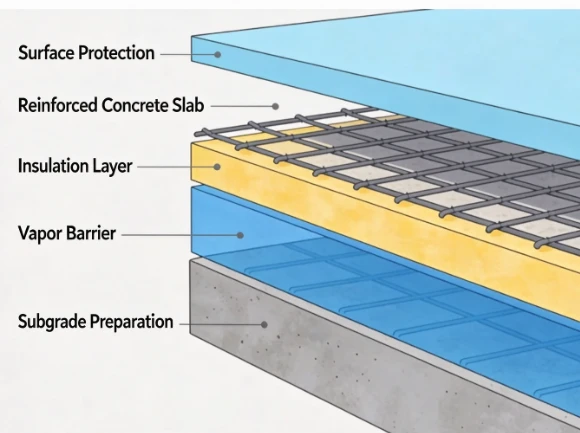
Why is floor insulation essential for cold rooms? It mainly reduces cold loss. With integrated moisture-proof and frost-heave prevention design, it protects the foundation from low-temperature damage. Without proper floor insulation, frozen and expanded soil will lift the floor and crack panels, causing severe structural risks.
Many clients invest heavily in refrigeration units but cut corners on floor construction. Within just two years, problems like floor cracking begin to appear. Once insulation fails, energy consumption can rise significantly - in many cases by more than 30% - and the cold chain system becomes unstable. The cold room floor is far more than ordinary flooring; it is the foundation of the whole cold chain system.
Henan Element New Materials Co., Ltd. has rich experience in overseas cold room projects since 2012. Our products are exported to more than 50 countries and regions. Based on numerous real projects, we list key checkpoints for cold room floor insulation before construction..
I. Five Key Requirements for Cold Storage Flooring
Cold storage flooring must withstand multiple challenges - low temperatures, high humidity, and heavy loads - and all five of the following criteria are essential:
| Core Requirement | Key Index (with test reference) | Common Problems |
|---|---|---|
| Vapor & Moisture Barrier | ≤0.03g/(m²·h) | Ground moisture rising, surface condensation |
| Freeze-Thaw Resistance | ≥F150 | Cracking & peeling after freeze-thaw cycles |
| Load Bearing Capacity | ≥3 t/m² | Collapse under forklift traffic |
| Wear Resistance & Anti-Slip | Max. wear depth ≤3 mm (Taber abrasion) | Surface dusting, slippery floor |
| Thermal Insulation | ≤0.024W/(m·K) |
Cold loss, high energy consumption |
💡 Key Reminder: Moisture-proofing and vapor barrier installation are the top priority. Many contractors skip the moisture-proof layer to meet tight construction deadlines-this is the primary reason why cold storage flooring fails prematurely. Element's PU core material has a standard density of 40–42 kg/m³ and a thermal conductivity (λ) of ≤0.024 W/(m·K); however, maintaining stable thermal insulation performance strictly depends on an intact, continuous vapor barrier.
II. Seven-Step Standard Construction Process
The entire flooring system consists of interconnected components, where each step directly influences the final service life:
Step 1: Substrate Preparation
The substrate must be level, dry, and free of loose dust. The moisture content must be kept below 8% by weight (tested by the CM method or plastic-sheet method), and surface unevenness must not exceed 3 mm over a 2 m straightedge.
Step 2: Installation of the Moisture Barrier
Install a PE moisture-proof membrane (with a thickness of ≥0.3mm), ensuring an overlap of at least 150mm. Seal all seams with specialized tape to create an effective barrier against ground moisture.
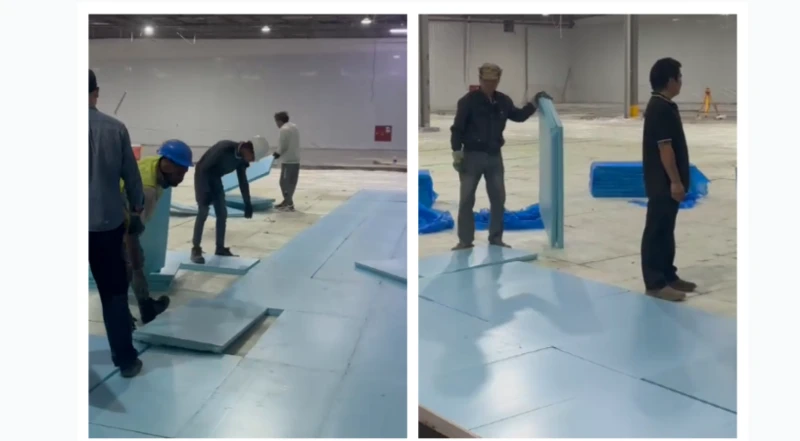
Step 3: Installation of the Insulation Layer
Use either extruded polystyrene (XPS) boards or polyurethane (PU) insulation boards, with the thickness determined by the required storage temperature. Lay the boards in a staggered pattern and fill any gaps tightly using expanding foam.
| Application | Temperature | Recommended Thickness |
|---|---|---|
| Chiller Room | 0 ~ -5℃ | 75–100 mm |
| Cold Storage | -5 ~ -10℃ | 100 mm |
| Freezer Room | around -18℃ | 150 mm |
| Deep Freezer | -25 ~ -35℃ | 175–200 mm |
| Blast / Ultra-low Freezer | below -35℃ | 200 mm+ |
Element PU sandwich panels are available in thicknesses from 40 mm to 250 mm, with standard metal facings between 0.4 mm and 0.7 mm. Their compressive strength can be customized based on load requirements, making them suitable for various applications, including walk-in cold storage units and large-scale low-temperature warehouses.
Step 4: Reinforced Concrete Pouring Pour concrete of grade C30 or above, minimum thickness 150 mm. Lay two-way steel mesh (bar ≥8 mm, spacing 200 mm) for crack resistance.
Step 5: Surface Protection Choose surface finish as required: wear-resistant hardened floor, epoxy mortar floor or emery wear-resistant floor. Standard epoxy flooring becomes brittle and cracks easily at low temperatures; only low-temperature-grade epoxy should be used in freezer rooms. Wear-resistant hardened flooring must be paired with a dedicated sealing system to prevent water penetration - without it, it is not suitable for freezer rooms.
Step 6: Expansion Joint Treatment Cut expansion joints every 6 m × 6 m, width 5–8 mm. Fill with elastic sealant to avoid random cracking from temperature stress.
Step 7: Curing Cover and cure concrete for at least 14 days after pouring. No loading on the surface during curing. Next construction can only start after curing finishes.
III. Selecting Models Based on Local Conditions
| Application Scenario | Temperature / Key Focus | Recommended Solution |
|---|---|---|
| Fruit & Vegetable Chiller | 0~5°C, moisture proofing priority | PE film + 100mm XPS + C30 concrete |
| Frozen Storage | -18~-25°C, freeze-thaw resistance + load bearing | Vapor barrier + 180mm PU + C35 concrete + emery topping |
| Logistics Cold Warehouse | Ultra-high load, large area | Reinforced vapor barrier + 200mm insulation + C40 steel fiber concrete |
| Pharmaceutical / Food Warehouse | Dust-free & clean, GMP / HACCP compliant | Vapor barrier + insulation + C30 concrete + low-temperature-grade epoxy self-leveling |
| Explosion-Proof Industrial Warehouse | Anti-static & explosion-proof, meet safety codes | Vapor barrier + insulation + anti-static concrete |
| Smart Cold Storage | Embedded sensors, automated supporting system | Integrated floor system + sensor network + high-strength wearing surface |
Whether you are designing a small walk-in cooler or a large logistics freezer, reliable cold room floor insulation lays the groundwork for stable operation and lower long-term energy bills.
Henan Element New Materials Co., Ltd. provides one-stop cold storage solutions, covering floor insulation system design, insulation panel production, cold room doors, refrigeration units and all supporting accessories. We aim to provide a complete package so that you do not need to source extra parts separately. Our technical team evaluates your working temperature, load demand, hygiene and compliance requirements to build a complete and tailored plan for your freezer project.
Share your project details with us, and our team will deliver a full, practical solution along with a competitive quotation.
01
High Quality
02
Advanced Equipment
03
Professional Team
04
Custom Service