

1. What Is PU Cold Room Panel Density?
PU foam density refers to the mass of polyurethane foam per unit volume, measured in kg/m³. It describes the density of the insulation core, not the weight of the finished panel.
The total panel weight also depends on its thickness and metal facings. Therefore, density alone cannot determine the quality of a PU cold room panel.
2. Does Higher Density Mean Better Insulation?
Not always. Insulation performance depends on more than foam density. Thermal conductivity, cell structure, blowing agent and production quality also matter.When comparing panels, pay attention to:
Thermal conductivity: Lower values generally indicate better insulation.
Cell structure: Uniform foam helps maintain consistent performance.
Panel thickness: Choose according to the required storage temperature.
Bonding strength: Good adhesion helps prevent the foam from separating from the metal facings.
Higher density may improve mechanical strength, but it does not automatically provide better insulation. Excessively high density can also increase cost and panel weight without a proportional improvement in performance.
3. What Happens If PU Foam Density Is Too Low?
If foam density is under the designed requirement, you may face these issues:
- Lower mechanical strength and poor dimensional stability
- Uneven foam structure, unstable insulation performance
- Shorter service lifespan
- Higher chance of delamination between foam core and metal facings
That said, density below 42 kg/m³ does not directly equal defective panels. The suitable density range changes based on product specs, site usage conditions and official test reports.
4. How Does Element Control PU Foam Density?
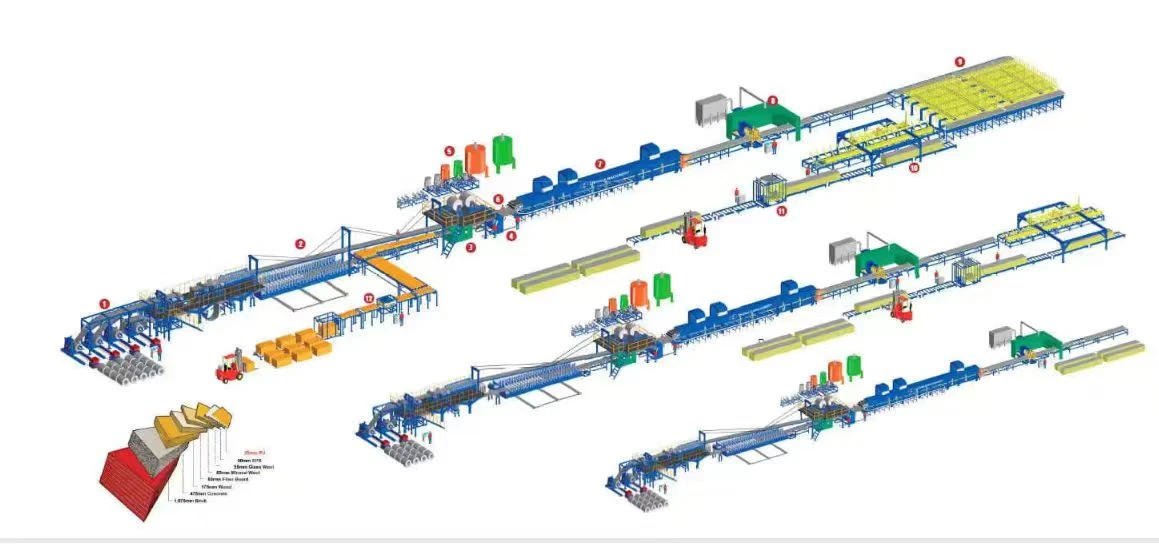
Element New Materials uses an Italian PUMA fully automatic PU panel production line. Raw materials are accurately proportioned before foaming, and the panels then pass through a double-belt curing system.
Automated production helps maintain consistent foam distribution, panel thickness and density across batches. Actual results still depend on raw materials, equipment settings and process control.
Main production steps:
Uncoiling Steel machine → film lamination → Roll forming → Double-Belt Curing & Forming → Laser-assisted band saw cutting → Fully automatic board handling system → Fully automatic strapping system
As a manufacturer of PU cold room panels, Element can coordinate production parameters with panel specifications and project requirements.
5. How to Test PU Foam Density
A basic density test involves measuring a foam sample's dimensions and weight, then calculating its volume and density.
Formula:
Density (kg/m³) = Mass (kg) ÷ Volume (m³)
For example, a sample weighing 0.04 kg with a volume of 0.001 m³ has a density of 40 kg/m³.
Sampling location and test methods can affect the result. For formal quality inspection, follow the applicable testing standards and sampling requirements.
6. How to Choose the Right Panel Thickness
Panel thickness should match the storage temperature, local climate, cold-room size, door opening frequency and refrigeration requirements.
| Application | Common panel thickness |
|---|---|
| Chiller (0 to +5°C) | 75–100 mm |
| Freezer (around -18°C) | 150 mm |
| Low-temperature or blast-freezing room (-25 to -35°C) | 175–200 mm |
These figures are general references, not fixed standards. The final thickness should be determined by the project's thermal requirements and refrigeration design.