

How to Choose PU Insulated Panels for Your Cold Storage
Choosing the right polyurethane (PU) insulated panel is essential for maintaining stable temperatures, reducing energy consumption, preventing condensation, and ensuring the long-term performance of your cold storage project.
Whether you are building a chiller room, freezer room, or blast freezer, here are six key factors to consider before purchasing PU insulated panels.
1. Choose the Right Panel Thickness
Panel thickness is one of the most important factors because it directly affects thermal insulation performance. The ideal thickness depends on the required storage temperature, environmental conditions, and energy-efficiency requirements.
Here this list for your reference-About panel thickness & temperture choose.
|
Application |
Typical PU panel thickness |
|---|---|
|
Chilled storage, 0°C to +10°C |
75–100 mm |
|
Freezer room, around -18°C |
100–150 mm |
|
Low-temperature storage, -25°C to -35°C |
150–200 mm |
|
Blast freezer or lower-temperature applications |
200 mm or more |
These are general guidelines, not fixed specifications. The final thickness should be determined by the operating temperature, local climate, room size, and refrigeration system design.
2. Check Thermal Conductivity and PU Density
Do not choose panels based on thickness alone. Check the technical specifications of the PU foam core.
Thermal conductivity (λ): A lower value indicates better insulation performance. For example, Element specifies a thermal conductivity of ≤0.024 W/(m·K).
PU core density: A consistent density helps support the panel's mechanical performance and dimensional stability. Element's stated specification is 42 kg/m³ ±2.
The following are the product performance specifications for polyurethane (PU) insulation panels.
| Item | Picture reference | Density kg/m³ | Nominal λ W/(m·K) | Panel Thick(mm) | R Value ㎡⋅K/W | U Value W/(m².K) |
| PU Sandwich Panel |  |
42 | 0.024 | 50 | 2.23 | 0.45 |
| 75 | 3.28 | 0.31 | ||||
| 100 | 4.32 | 0.23 | ||||
| 150 | 6.4 | 0.16 | ||||
| 200 | 8.48 | 0.12 | ||||
| 250 | 11.02 | 0.19 |
3. Select the Right Surface Material

The panel's outer metal sheets protect the insulation core and affect durability, hygiene, and corrosion resistance.
|
Surface material |
Suitable applications |
|---|---|
|
Pre-painted galvanized steel (PPGI) |
General cold rooms, warehouses, and food storage |
|
Stainless steel 304 |
Food processing, hygiene-sensitive environments, and frequent cleaning |
|
Stainless steel 316 |
Projects requiring enhanced corrosion resistance |
|
Embossed aluminum |
Selected applications requiring a lightweight, specialized finish |
When comparing quotations, confirm the actual metal thickness, coating specification, and material grade rather than comparing surface appearance alone.
4. Evaluate Fire Performance
Fire performance is particularly important for large cold storage warehouses, food factories, and pharmaceutical facilities.
Before ordering, confirm:
Whether PU or PIR insulation is specified.
The fire classification required by local building regulations.
Reference for Authentic Polyurethane Test Reports-Henan Element New Materials Co.,Ltd


5. Check the Joint System and Installation Quality

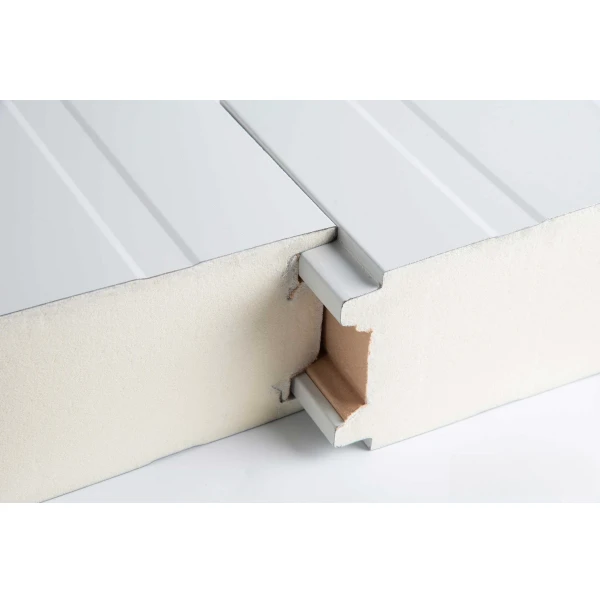
Even high-quality PU panels can underperform if joints are poorly sealed. Air leakage and thermal bridges can increase refrigeration loads and cause condensation.
For areas up to 500 square meters, we generally recommend using polyurethane hook-joint panels; for areas exceeding 5,000 square meters, we recommend using tongue-and-groove panels.
|
Feature |
Hook-Type Panel (Cam-Lock Panel) |
PU Edge-Joint Panel (tongue-and-groove panels) |
|---|---|---|
|
Connection Method |
Built-in cam locks are tightened with a wrench, creating a tight interlocking joint. |
Panels connect through interlocking male-and-female edges. |
|
Manufacturing Process |
Flexible production using manual or semi-automated foaming molds; built-in metal or plastic locks. |
Mass-produced on continuous production lines; length is customizable, width is fixed. |
|
Airtightness & Insulation |
Excellent. Tight cam-lock joints minimize gaps and thermal bridges. |
Moderate. Joints may require foam or sealant for airtightness. |
|
Disassembly & Reuse |
Reusable. Can be disassembled with minimal panel damage. |
Less reusable. Usually permanently joined; disassembly may damage edges or surfaces. |
|
Cost |
Higher due to labor and built-in locking hardware. |
Lower, suitable for large-scale industrial production. |
6. Compare Total Cost, Not Just Panel Price
A low quotation does not necessarily mean a lower project cost. Compare suppliers based on the complete specification.
|
Item to compare |
What to confirm |
|---|---|
|
Panel thickness |
Same thickness and insulation requirements |
|
Core specifications |
Comparable thermal conductivity and density |
|
Metal facings |
Same material grade and thickness |
|
Dimensions |
Same effective width, length, and customization |
|
Accessories |
Corners, flashings, sealants, and fasteners included or excluded |
|
Delivery |
Production lead time, packaging, and shipping arrangements |
|
Warranty |
Written coverage and applicable conditions |
For an accurate quotation, provide your supplier with the required panel area, storage temperature, panel dimensions, surface material, destination port, and any fire-rating requirements.
Why Choose Element PU Insulated Panels?

Henan Element New Materials Co., Ltd.
Element manufactures PU insulated panels for cold rooms, freezers, and other insulated building applications.
PU panel thermal conductivity: ≤0.024 W/(m·K)
PU core density: 42 kg/m³ ±2
Customizable panel thickness and dimensions
Five-year after-sales product support; free drawing and measurement services.
Frequently Asked Questions
Q1: What thickness of PU panel is best for a -18°C freezer?
A 150 mm PU panel is a common starting point for a -18°C freezer, but 100–150 mm may be appropriate depending on the project.
Q2: Is higher PU density always better?
No. Density alone does not determine insulation quality. Thermal conductivity, foam structure, adhesion, mechanical strength, and manufacturing consistency should also be evaluated.
Q3: How can I compare PU panel manufacturers in China?
Compare documented technical specifications, production capabilities, quality-control procedures, fire-test certificates, references from similar projects, warranty terms, and total delivered cost.
Q4: Can PU panels be customized?
Yes. Many manufacturers offer different thicknesses, lengths, effective widths, metal facings, and colors. Confirm the available production range before placing an order.