

The Engineering Logic Behind 1120mm Panel Width: Structural Integrity and Installation Efficiency
In the cold storage construction industry, panel width is often treated as a simple dimensional specification. However, for engineers and project managers, the choice of panel width-specifically the 1120mm effective cover width-is a critical design parameter that balances structural mechanics, thermal performance, and logistical efficiency.
At Element New Materials, we frequently receive inquiries asking why our standard production width is 1120mm rather than the traditional 1000mm or 1150mm. This article breaks down the engineering rationale behind this optimized modular design.
1. Structural Mechanics: Optimizing the Span-to-Depth Ratio
Cold storage panels function as stressed-skin structures. The metal skins (PPGI/SS) act as flanges, while the PU/PIR core acts as the web in a composite beam.
Deflection Control: Under wind load or negative pressure (common in blast freezers), wider panels experience greater bending moments. At 40mm or 50mm thicknesses, increasing the width beyond 1120mm significantly increases mid-span deflection. Over time, this can lead to visible waviness or joint fatigue.
Shear Transfer Efficiency: The 1120mm width ensures optimal shear stress transfer between the metal skin and the insulation core. This prevents "skin buckling" during extreme temperature fluctuations (-45℃ to +30℃), maintaining the panel's flatness over decades of thermal cycling.
The Sweet Spot: Our structural testing confirms that 1120mm represents the mathematical optimum for 40-100mm thick panels, providing maximum rigidity without requiring additional internal steel reinforcement.
2. Thermal Performance: Minimizing Linear Thermal Bridges
Every vertical joint between panels is a potential linear thermal bridge (Ψ-value). While wider panels mean fewer joints per square meter, they also increase the risk of installation gaps due to cumulative tolerance errors.
Tolerance Stack-up: In a 30-meter long wall, using 1000mm panels requires 30 joints; using 1120mm panels requires ~27 joints. Fewer joints mean fewer opportunities for sealant failure or camlock misalignment.
Effective Coverage: It is crucial to distinguish between nominal width and effective cover width. Our 1120mm specification refers to the installed coverage. This eliminates the guesswork for quantity take-offs and ensures zero material waste on-site.
3. Logistical & Installation Efficiency
Engineering doesn't stop at the factory gate. The 1120mm module is designed for real-world constraints:
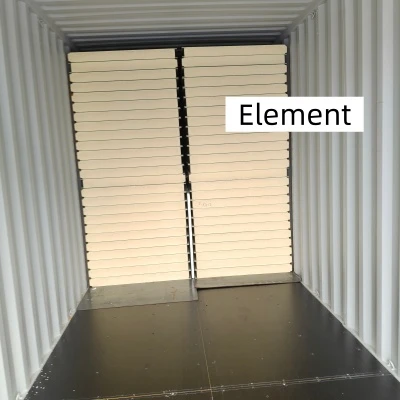
Container Optimization: 1120mm is mathematically aligned with standard ISO container internal dimensions. For 11.85m long panels, this width allows for precise stacking patterns in 40HQ containers, maximizing payload utilization by up to 8% compared to non-modular widths.
Ergonomics & Safety: A 12m x 1120mm x 50mm PU panel weighs approximately 45-50kg. This is within the safe two-person manual handling limit. Wider panels (e.g., 1200mm+) often require mechanical lifting aids even for installation, increasing on-site complexity and cost.
Compatibility Ecosystem: 1120mm has become a de facto industry standard for accessories. Our panels seamlessly integrate with global-standard cold room doors, aluminum channels, and silicone sealing systems, ensuring you are never locked into a proprietary ecosystem.
The 1120mm panel width is not an arbitrary manufacturing constraint; it is the result of decades of engineering refinement. It offers the best compromise between structural span capability, thermal envelope integrity, and on-site constructability.
When planning your next cold storage project, let us handle the details; simply provide us with the dimensions, required temperature, and local voltage, and we will generate a comprehensive cold storage solution for your consideration.